
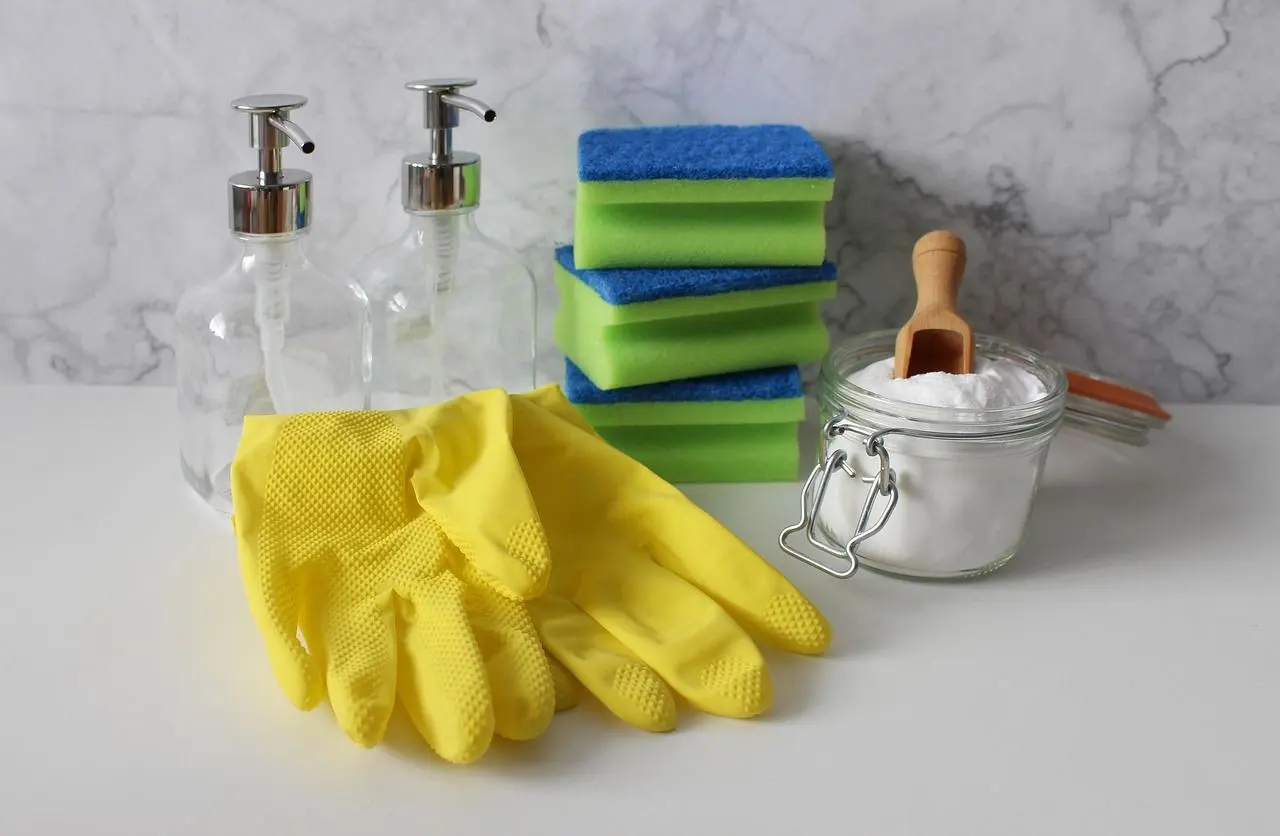
Wondering whether cleaning with vinegar and baking soda is worth it? You’ll get good results on grease, hard water and odors, but not on disinfecting, and never beside bleach.
This guide sits inside our collection of cleaning tips for the home.
| Item | Value |
|---|---|
| Vinegar all-purpose spray | One part vinegar to one part water |
| Grease and grime solution | 1/4 cup baking soda, 1/2 cup vinegar and 1 gallon hot water |
| Drain treatment | 1 cup baking soda, then 1 cup hot vinegar |
| Drain wait before flushing | 5 minutes, then 2 quarts hot water |
| Air-freshening spray | 1 teaspoon baking soda, 1 tablespoon vinegar and 2 cups water |
| Vinegar with chlorine bleach | Never mix |
These figures come from Cornell Cooperative Extension and New Mexico State University Extension. Recommendations can change, so check the source before you rely on them.
Why the two cleaners behave so differently
The University of Arkansas Extension sorts cleaners by chemistry. Its page says acids break down rust, mineral deposits and hard water stains, while alkalis are good for removing dirt, fat and grease. It lists vinegar and lemon juice as the acid alternatives, and baking soda as the mild alkali.
In practice, that gives you a simple rule for choosing:
- Vinegar for rust, hard water spots, glass and chrome fixtures.
- Baking soda for greasy surfaces, refrigerators, porcelain enamel and countertop stains.
An Ohio State University Extension post backs up both halves of that rule. It describes vinegar and lemon juice as good basic cleaners that also give a shine, and it says baking soda can be used to clean refrigerators, clean porcelain enamel and remove stains from countertops.
The same Arkansas page also lists mold among the jobs suited to acids. For a bathroom, our walkthrough on how to remove mold from bathroom surfaces covers the whole process. The Arkansas guide adds that you should start with the mildest cleaner that could work, and that hot water cleans much better than cold.
Recipes that extension guides actually publish
A simple all-purpose spray
Cornell Cooperative Extension suggests combining one part vinegar with one part water in a spray bottle. If you dislike the smell, it says you can mellow it by adding lemon juice.
A bucket solution for grease and grime
For heavier jobs, the same Cornell page gives a solution of 1/4 cup of baking soda, 1/2 cup of vinegar and 1 gallon of hot water. It is meant for grease and grime, and to eliminate odor as well. Read more at the Cornell page before you mix a batch.
A light spray for stale air
New Mexico State University Extension mixes 1 teaspoon of baking soda, 1 tablespoon of vinegar and 2 cups of water in a pump spray bottle. It tells you to wait until the foaming stops before you put the sprayer back on and shake well. For the fridge, it recommends simply placing an open box of baking soda inside to absorb food odors.
If a smell keeps coming back, our guide on how to get rid of odors in the house goes further than a spray can.
How do you clear a drain or clean a microwave?
For a slow drain, Cornell Cooperative Extension pours 1 cup of baking soda down the drain, followed by 1 cup of hot vinegar. It then waits 5 minutes before flushing with 2 quarts of hot water. The steps run in this order:
- Pour the baking soda down the drain.
- Follow it with the hot vinegar.
- Wait the stated time.
- Flush with hot water.
- Repeat if needed, since the page says the process can be repeated a few times.
The microwave is easier. Cornell says to mix a few tablespoons of baking soda with water in a microwave-safe cup and boil it for a few minutes, which leaves the inside damp and easy to wipe with a paper towel or dishcloth (source).
Where these two fall short
The biggest gap is disinfecting. The University of Arkansas Extension states that DIY green cleaners are not recommended for disinfecting against the SARS-CoV-2 virus. Cornell’s page, by contrast, calls vinegar an effective cleaning agent and disinfectant, so the sources do not fully agree.
It helps to separate two jobs. Ohio State Extension explains that sanitizing means reducing germs to a safe level so that illness is not likely to occur, which is a different goal from lifting dirt off a counter.
Gritty scrubs are another trap. The same Ohio State post advises avoiding scouring powders where possible because they will scratch some surfaces, so test any abrasive paste somewhere out of sight first.
Safety rules before you mix anything
Natural does not mean consequence-free. New Mexico State University Extension says to never mix chlorine bleach with any other cleaning agent, such as ammonia or vinegar, because it can create toxic fumes.
Ohio State Extension says the same about ammonia: do not combine it with any other cleaners (source). The New Mexico guide adds a few habits worth adopting:
- Mix cleaning solutions in a well-ventilated area.
- Never transfer a product into a food or drink container.
- Copy the whole original label onto any new container.
The Arkansas page also reminds readers that green cleaners are gentler but should not be consumed.
Frequently asked questions
Can I put vinegar and baking soda in the same bottle?
Show answer
A New Mexico State University Extension recipe does, in dilute amounts, and it waits for the fizzing to stop before the sprayer goes on. Drain guides usually add the two in sequence instead of pre-mixing them.
What should I use on hard water spots?
Show answer
Reach for the acid. The same New Mexico guide describes full-strength vinegar or lemon juice as a way to lift rust stains and hard water deposits (source).
Can I add vinegar to bleach for extra power?
Show answer
No. Extension guidance says to keep chlorine bleach away from vinegar and every other cleaner, so use each product on its own and rinse surfaces between them (source).
Is making my own cleaners better for the environment?
Show answer
Cornell Cooperative Extension says homemade products mean less impact from shipping and production and fewer plastic bottles. It also acknowledges that people are busy, so do what works for you.