
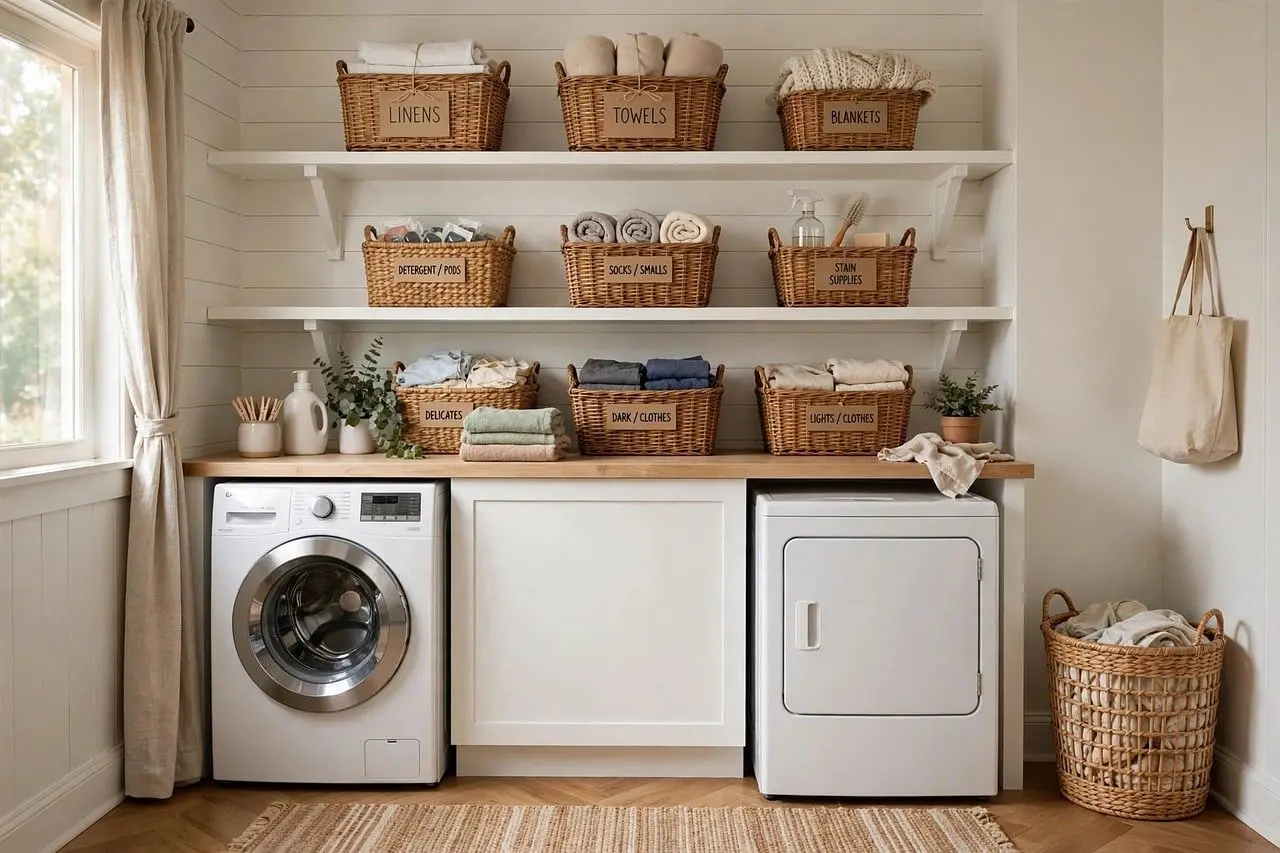
Is your laundry room a cramped pile of baskets and bottles? Laundry room organization works best when you give every task its own zone and keep the area around the dryer clear.
This guide sits within the wider topic of home organization, which covers practical plans for every room.
| Item | Value |
|---|---|
| Home dryer fires reported (USFA figure) | Nearly 2,900 home dryer fires per year |
| Estimated property loss from those fires | $35 million in property loss |
| Dryer vent cleaning | At least once a year |
| Maximum vent duct length with two elbows | 20 feet |
| Length each 90-degree bend counts for | 5 feet of straight duct |
These figures come from the Ashburn Volunteer Fire and Rescue Department’s dryer safety page, which cites the U.S. Fire Administration, and from This Old House. Statistics and guidance can change, so check the sources before you rely on them.
Start with zones before you buy storage
Clutter in a laundry room usually comes from several tasks overlapping in the same spot. Trace one load from dirty to put away, note where you stop and shuffle things around, and give each stage its own zone.
- Sort: a hamper or divided baskets near the door, so dirty clothes never pile on the machines.
- Wash: detergent, stain remover and a small bin for pocket finds within arm’s reach of the washer.
- Dry: the dryer and the space around it, kept clear for airflow and access.
- Fold: a countertop, a fold-down shelf or a sturdy table that you clear after every session.
- Return: a hanging rail and one labelled basket per person for clean clothes.
Floor space is usually the scarcest resource, so a look at small space storage ideas can show how walls, doors and the gap above the machines can carry some of the load.

Where should detergents and cleaning supplies go?
Keep the products you use every wash at hand height beside the washer, and move bulk refills and rarely used items to a higher or lower shelf. A caddy with a handle or a set of open bins stops bottles from tipping and shows at a glance what is running low.
The rule that matters most for safety is distance from the dryer. Coit’s dryer safety guidance says to store flammable items such as cleaning supplies, clothing and paper products away from the dryer, and Servpro, citing the U.S. Fire Administration, adds that the surrounding area should be free of materials that may catch fire. Sources: Coit and Servpro.
What goes into the drum matters too. This Old House warns that towels or rags with traces of gasoline, alcohol, cooking oil or cleaning agents can start a fire when the dryer heats up, and that rubber-backed items such as a bath mat do not belong inside. A separate, labelled bin for oily or stained rags keeps them out of ordinary loads.
Plan the layout around the dryer
The dryer is the one appliance that dictates where everything else can go, because its exhaust has to reach the outdoors. According to This Old House, the overall duct length with two elbows should not exceed 20 feet, and each 90-degree bend counts as 5 feet of straight duct.
In practice, a dryer placed close to an exterior wall keeps the run short and leaves you more allowance for bends. The same page names four-inch round steel ducts as the best option, because their smooth walls collect lint more slowly and are easier to clean.
The Ashburn Volunteer Fire and Rescue Department relays USFA advice to use metal venting rather than plastic or foil accordion-type ducts. It also says the exhaust should go outdoors, not into an attic, a crawl space or the home itself.
Lint is the main reason layout and housekeeping are linked. Consumer Reports, citing NFPA figures, says about 27 percent of home dryer fires are caused by lint accumulation that constricts the ductwork.
- Leave enough gap behind and beside the dryer to reach the vent connection and clean there.
- Avoid stacking baskets, boxes or shelves right against the machine.
- Do not plug the dryer into an extension cord or power strip, as the Ashburn page warns.
- Use a licensed professional to move a gas line, change an outlet or rewire; these jobs are beyond simple homeowner tasks.
A simple maintenance routine for lint and vents
A routine is easier to keep when it is tied to a place you see. Tape a short checklist inside a cabinet door or beside the dryer, and tick it off as you go.
- Clean the lint filter before and after each load, which the Ashburn page calls one of the simplest ways to prevent dryer fires.
- Every three months, clear lint from the vent pipe and from behind the dryer, as Servpro lists USFA tips.
- Every six months, or more often, scrub the filter with a nylon brush so it does not clog.
- Have the vent cleaned at least once a year, in line with the Ashburn page.
Sources differ on frequency, so treat these as a starting point and follow your dryer’s manual. Watch for warning signs: Consumer Reports lists clothes taking longer to dry, clothes that are very hot afterwards, or the machine shutting down unexpectedly.
Also avoid running the machine while the house is empty or everyone is asleep. Coit advises against it, and a gas dryer should be inspected by a professional, including its gas line and connection.
Handle manuals, receipts and odds and ends
Laundry rooms quietly collect paper: appliance manuals, warranty cards, receipts and care labels. Keep one folder for them, using the approach in how to organize paperwork at home, and the drawers stay free for supplies.
Give small items a home as well. A shallow tray catches coins and tissues from pockets, a single basket takes odd socks, and a hook holds the lint brush so it is always where you need it.
Frequently asked questions
How often should the lint screen be emptied?
Show answer
Make it part of loading and unloading: clear the screen as you start a cycle and again once it ends. Fire-service guidance in the Ashburn Volunteer Fire and Rescue Department’s dryer page names a neglected lint trap, vent and exhaust duct as the leading cause of dryer fires.
Which vent material is best?
Show answer
Rigid metal beats flexible plastic or foil, which can sag and trap lint in low spots. Smooth steel ducting is the choice highlighted by This Old House for the same reason.
Can I keep laundry baskets next to the dryer?
Show answer
Keep them a short distance away rather than touching the machine. Fresh towels and clothing are among the items that Coit says belong away from the dryer, along with cleaning supplies and paper.
Who should handle gas or electrical changes?
Show answer
Leave them to a licensed professional. Moving a gas connection or altering wiring is not a simple homeowner job, and a dryer should never be run from an extension cord or power strip.